
Modern Warfare: Three Ways to Weaponise a Retreat
Issue 45, 14 June 2026

What should you do when you are outnumbered in battlefield and in debt of your opponent? The Battle of Chengpu fought in 632 BCE provides some insights. For this issue, let’s read an article in PLA Daily by Su Tianhui (苏天会, Sū Tiānhuì) which takes one of the most familiar phrases in the Chinese language and reads its origins in warfare. The phrase is “retreat ninety li” (退避三舍, tuì bì sān shè). This idiom is a parable about keeping your word. The article argues that the retreat was not just a gesture of restraint, but also a strategy.
Battle of Chengpu
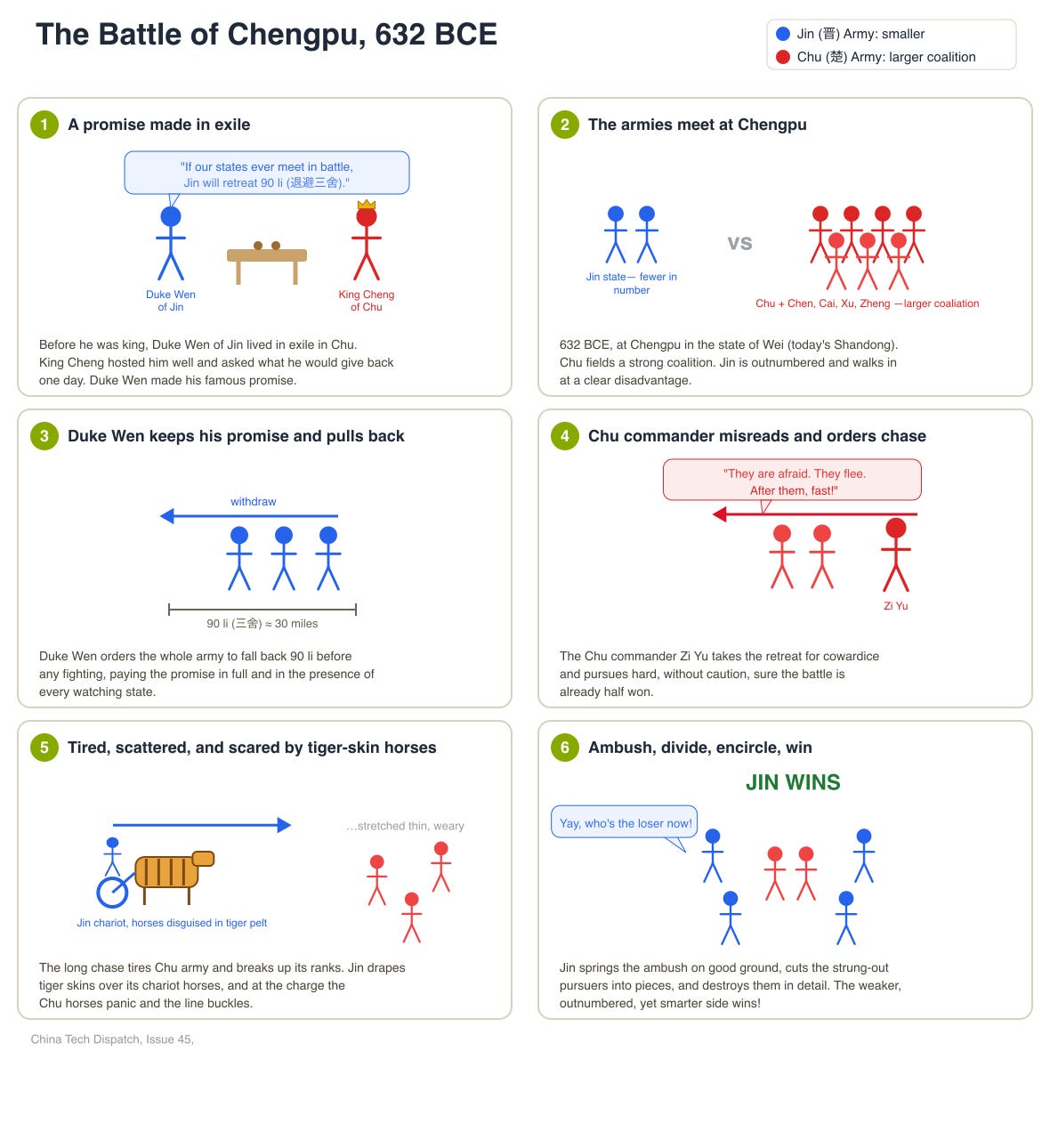
The Battle of Chengpu was fought in 632 BCE between the states of Jin (晋, Jìn) and Chu (楚, Chǔ), and it became one of the classic cases in Chinese military history of the underdog defeating the stronger adversary.
The story begins years before the battle. Before he took the throne, Duke1 Wen of Jin (晋文公, Jìn Wén Gōng) lived in exile in Chu, where King Cheng of Chu (楚成王, Chǔ Chéng Wáng) received him with respect and hosted a banquet in his honour. During the banquet the king asked what Duke Wen would offer in return one day. Duke Wen promised that if Jin and Chu ever met in battle, the Jin army would withdraw ninety li (三舍, sān shè). That promise is the origin of idiom “退避三舍.”
For broader context, Duke Wen spent roughly nineteen years moving between states in exile before returning to take the Jin throne, which is part of why his eventual command carried such authority. The battle itself took place at Chengpu, in the territory of the state of Wei (present day Shandong province).
When the two states finally met in 632 BCE, Chu was fielding a strong coalition that drew in contingents from Chen, Cai, Xu, and Zheng. The author refers to this as an army strong in soldiers and horses. Jin state was at a numerical disadvantage. Duke Wen of Jin kept the promise and ordered the whole army to fall back ninety li before engaging. The Chu commander 子玉 (Zǐ Yù) read the withdrawal as cowardice and pursued without caution. The Jin army then used the ground to its advantage, set an ambush, divided the pursuing force, and destroyed it in pieces. Jin kingdom won.
Three Ways to Weaponise a Retreat
Duke Wen used the withdrawal to reconstruct the factors that decide a battle, a move the author calls “reconstructing the battlefield’s victory-determining factors” (重构战场制胜要素, chóng gòu zhànchǎng zhì shèng yàosù). Su Tianhui frames thisretreat as operating in three distinct modes
Retreat as moral framing
Retreat as opportunity creation
Retreat as deception
Each mode is a lesson in how the act of pulling back can be turned into an instrument of victory.
Retreat as moral framing
The author reads withdrawal as a political performance built into the strategic design, not a tactical move that happened to look honourable.
By paying the promise in front of the watching states, Duke Wen seized the moral high ground inside the ritual order of the day.
He established Jin as a state that honoured its word, which carried real weight in a system that prized the ethics of war.
He put Chu commander Zi Yu (子玉, Zǐ Yù) in a position with no good move. Halting the pursuit would drain Chu’s momentum and morale. Pressing the pursuit would carry the reputational cost of attacking a state that was visibly keeping its word. Author phrases this as the “charge of attacking one who keeps his promise” and “using injustice to attack the just.”
更使楚军统帅子玉陷入两难:若停止追击,则士气受挫;若继续进攻,就极有可能背负”进攻守诺者”“以不义攻有义”的舆论压力。(“..and it further put the Chu commander Zi Yu in a dilemma. If he halted the pursuit, his morale would suffer. If he continued the attack, he would very likely bear the public-opinion pressure of ‘attacking one who keeps his promise’ and ‘using injustice to attack the just.’”)
This line from the article nicely sums up retreat as moral framing:
晋军的退却本质上是一场精心设计的”攻心战”,晋文公利用当时的社会环境占据了”道义”的制高点,巧妙消弭了楚军初至的”兵锋锐气”。 (“The Jin withdrawal was at root a carefully designed ‘attack on the mind.’ Duke Wen used the social context of the day to seize the moral high ground, and skilfully dissolved the initial sharpness of the freshly arrived Chu force.”)
The term “attack on the mind” (攻心战, gōng xīn zhàn) used in the article refers to psychological warfare.
Retreat as opportunity creation
Next, author argues that the withdrawal manufactured the conditions for the ambush by changing the enemy rather than by fighting it.
The long pursuit fatigued the Chu troops and wore down the men and horses.
The chase dissolved Chu’s orderly formation as faster and slower units stretched apart.
The pursuit drew the detachment of the commander Zi Xi (子西, Zǐ Xī) out beyond the support of the Chu main body, where the Jin commander Xian Zhen (先轸, Xiān Zhěn) caught and defeated them.
晋军这种”主动退却—诱敌分散—分割歼灭”的作战链,本质是通过空间置换将敌军整体优势解构为局部劣势,以此换取战场主动权。 (“The Jin army’s chain of ‘active retreat, lure the enemy into dispersion, divide and destroy’ was at root a use of spatial substitution to break the enemy’s overall superiority down into local inferiority, exchanging space for battlefield initiative.”)
Important phrase here is ‘spatial substitution’ (空间置换, kōng jiān zhì huàn). It refers to the idea that giving up ground can buy a more valuable thing, that is initiative.
Retreat as deception
Next, Chu held the first-mover advantage (先发优势, xiān fā yōushì). In battlefield, the natural edge belongs to the first mover. They control the tempo and set the terms of engagement. A side which only reacts can fall into a “catch-up trap” (追赶陷, zhuīgǎn xiànjǐng). Duke Wen avoided that trap by layering deception. Hence, moving second became an advantage rather than a handicap. This posture is referred in the article as “gaining mastery by striking later” (后发制人, hòu fā zhì rén). Author highlights three deceptions here:
Deception of intent: So that the withdrawal is read as cowardice rather than as a lure.
Deception of force composition: Decoy units read as the main body and drew Chu attacks onto empty positions.
Deception of equipment: By using tiger skin on horses
在战斗中,晋军精选战车辕马,将虎皮披覆于马身,当战车冲锋时,披着虎皮的战马在烟尘中奔腾,如同猛兽出笼。 (“In the battle the Jin army carefully chose the chariot lead-horses and draped tiger pelts over their bodies, so that when the chariots charged, the tiger-clad horses came surging through the dust and smoke like wild beasts breaking out of a cage.”)
Lessons for Modern Intelligent Warfare
All of history is a lesson to those who are willing to learn from it. So, of course we have lessons on modern intelligent warfare from a battle fought more that 2500 years ago.
First, build the contest over legitimacy into the operational design from the start. The author argues that where Duke Wen’s moral high ground worked inside a closed system of shared ritual, the modern operation sits inside a connected global media environment where any tactical act can be reframed instantly as a question of legitimacy. It names the resulting prize as “the right to dominate the legitimacy narrative of war” (战争合法性叙事主导权, zhànzhēng héfǎxìng xùshì zhǔdǎo quán), and calls for presenting the image of a “army of righteousness” (正义之师, zhèngyì zhī shī) while avoiding the enemy’s moral traps.
Second, trade local control for system collapse. The article extends spatial substitution to system-of-systems combat, arguing that a force can deliberately give up local battlefield control to induce information-flow lag and fire-chain breakdown in an opposing system, then concentrate force against the fissures that open up. It is referred as a strike on the acupressure point (点穴式打击, diǎn xué shì dǎjī).
Third, treat the fog of war as something you manufacture, not just endure. The article argues that technology has thickened rather than dispersed the fog of war (战争迷雾, zhànzhēng míwù), spreading deception across the electromagnetic, cyber, and public-opinion domains, and it calls on forces to become the designer of battlefield surprise rather than its bearer, holding to the principle of “controlling the enemy rather than being controlled by the enemy” (致人而不致于人, zhì rén ér bù zhì yú rén).
Fourth, do not assume that moving first wins. First-mover advantage and the catch-up trap is true, but not always. The side which fights from material or other disadvantage can still take the initiative through better reading of the moment and better shaping of the situation. The later mover is not the loser by default.
Why Does It Matter?
It was an insightful read. Not only it helped me put another ancient battle into modern context, but also helped me understand origin of a famous Chinese idiom. Apart from the lessons on modern intelligent warfare, the point on legitimacy framing of operations also stuck with me.
The legitimacy framing worked for Duke Wen because he operated inside a particular system. Keeping his word seized the moral high ground because the Spring and Autumn period functioned as something close to a closed feudal order with shared ritual and norms among the noble houses. The promise was clear to everyone watching, and its violation by the other side would have carried a cost everyone recognised. Designing an operation around legitimacy requires reading the norms of the time correctly, because the same gesture carries different weight in different normative systems. A move that earns moral authority in one order may earn nothing in another. In short, know your audience.
Thanks for reading. Until next time.
The Chinese title 公 (gōng) is the highest of the five Zhou nobility ranks 公侯伯子男 (gōng hóu bó zǐ nán), which English roughly translates as duke, marquis, count, viscount, and baron. The European feudal analogy is loose, since the Zhou order arranged its vassal states inside a ritual hierarchy rather than a fief-and-tenant pyramid. However, “duke” seems to be the standard translation in major Anglophone scholarship. Jin was formally a marquis-ranked state (侯, hóu), yet its rulers are conventionally styled 公 as a courtesy and in posthumous naming, which is why 晋文公 (Jìn Wén Gōng) comes into English as Duke Wen of Jin rather than Marquis Wen. Any input on appropriate translation is welcome.
Well articulated and contextually relevant to today's modern warfare tactics. Brilliant article!
Brilliant article. Thank you! I especially appreciate your inclusion of the original Chinese.