
Modern Joint Operations: Ancient Fish Trap That Beat A King
Issue 44, 17 May 2026

A recent article in PLA Daily by Jiang Ying (蒋瑛, Jiǎng Yīng) makes the argument that the only constant in military affairs is the obligation to adapt to changing social, technological, and political conditions. The most interesting reference in the article is to the “Fish-Scale” or “Yuli Formation” (鱼丽之阵, yúlì zhī zhèn).
Duke Zhuang of Zheng (郑庄公, Zhèng Zhuāng Gōng)1 used it to defeat King Huan of Zhou (周桓王, Zhōu Huán Wáng) at the Battle of Xuge (繻葛, Xū gé ) fought in 707 BCE.
Fish-Scale/Yuli Formation
The historical setting and the battle itself come from the Zuo Zhuan (左传, Zuǒ Zhuàn) under its entry for 707 BCE.2 The article cites the broad outline but adds doctrinal interpretation that the classical text does not carry.
In late Spring and Autumn period, the Zhou royal house begun a decline that would last for next five-centuries. Due to the widespread use of iron tools in agriculture, population had grown and feudal vassal states whose ritual deference once defined the Zhou order had become economic and military centres in their own right. The state of Zheng (郑, Zhèng) was one of them. Duke Zhuang had stopped attending court and had absorbed territory the royal house considered its own. In 707 BCE King Huan marched against the state of Zheng as the head of an allied force drawn from Chen, Cai, and Wei. Author Jiang Ying frames this opening as a reversal of offence and defence (攻守易形, gōng shǒu yì xíng) in which a vassal state could now challenge the king.
The Fish-Scale formation sat at the core of Duke Zhuang’s campaign. The classical text Zuo Zhuan describes its composition in technical detail. Formation segments (偏, piān) of chariots were placed at the front, and five-soldier infantry units (伍, wǔ) were placed behind, with the infantry filling the gaps between the chariot. The classical text gives the compact phrasing “先偏后伍,伍承弥缝” (Xiān piān hòu wǔ, wǔ chéng mífèng, the 偏 in front, 伍 behind, 伍 filling the gaps). Jiang Ying’s article places infantry units around each chariot’s left, right, and rear positions. This is a reasonable reconstructive reading, but a bit different from the Zuo Zhuan description. Either way, the result was a tightly packed unit in which chariots provided shock and infantry provided manoeuvre and gap-filling. The conventional Western Zhou battle line had placed chariots in compact ranks at the front with infantry massed behind. The fish-scale formation broke that block up and produced a repeatable chariot-plus-infantry cell that could pivot, change direction, and absorb pressure without losing internal coherence.
In absence of authoritative diagrams of the 鱼丽之阵 (Yuli formation), I tried to interpret sources and sketched how the formation might have looked like. However, different sources seem to paint slightly a different picture. So, these interpretations are based on my understanding. AI tools were used to create the sketches below. Any inputs or corrections to these interpretations are welcome.
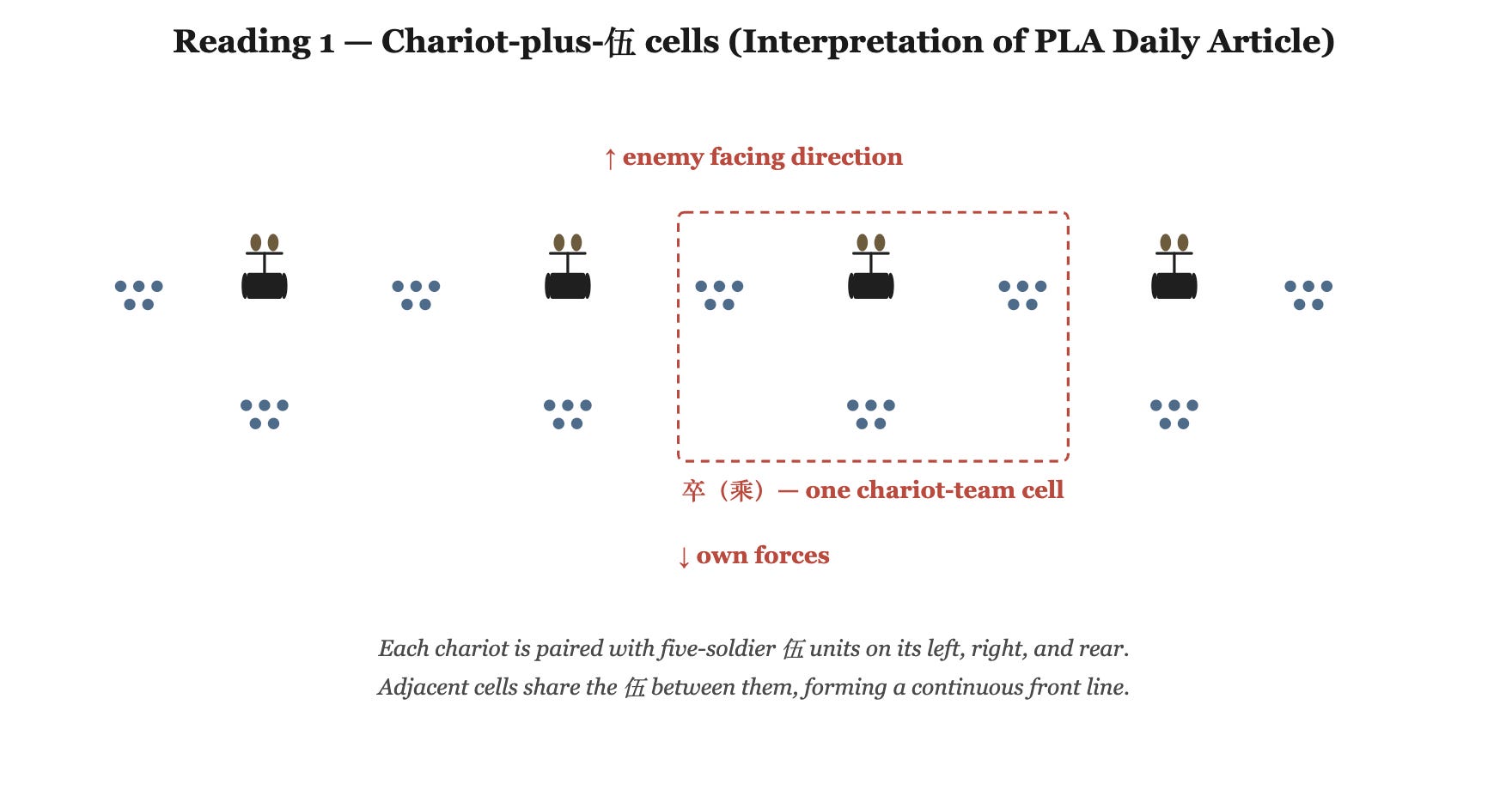
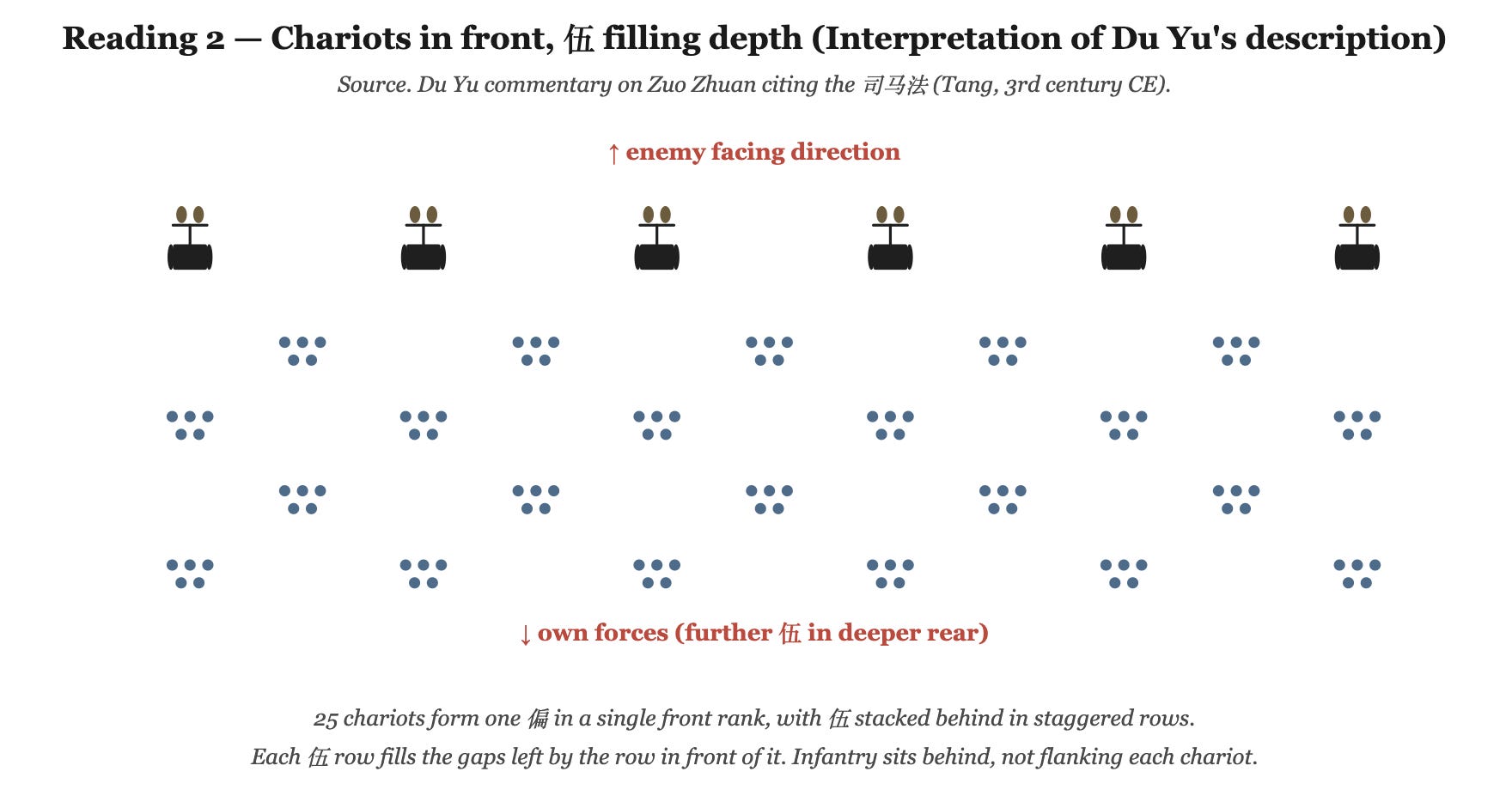
Jiang Ying frames the fish-scale formation as Duke Zhuang’s tactical answer to the orthodox royal disposition. The reading is similar to the historical record on the broad architecture but more interpretive on the doctrinal lesson. The article emphasises two effects, mobility and integrated offence-defence.
The passage describes the formation’s construction as follows:
郑庄公另辟蹊径,摒弃”堂堂之战”,打破传统车步配置模式,以五人为单位,分散配置于每辆战车的左右两侧及后方,形成车步相依、疏密有致的”鱼丽之阵”。 (”Duke Zhuang of Zheng struck out on a new path, eschewing the conventional “honorable battle” and breaking with the traditional deployment patterns for chariots and infantry. Organizing his troops in units of five, he dispersed them to the left, right, and rear of each chariot, thereby forming the “Fish-Scale Formation” (Yuli formation), a configuration characterized by the mutual interdependence of chariots and infantry, arranged in a pattern of calculated density and spacing.”)
The phrase “honorable battle” (堂堂之战, táng táng zhī zhàn) is the author’s way of naming what Duke Zhuang rejected. It refers to the formal, ritual-style Western Zhou battle in which two armies in orthodox formation faced each other and engaged on previously agreed terms. The choice of phrasing matters. By framing Duke Zhuang as a rejecter of 堂堂之战, Jiang Ying makes him a rejecter of the Western Zhou ritual order itself, not just a tactician choosing a different formation.
From 707 BCE to Modern Intelligent Warfare
The pivot from historical case to contemporary doctrine arrives in a single passage that does most of the doctrinal work in the section.
“鱼丽之阵”的胜利充分证明,战术革新是提升战斗力的有效途径,其中蕴含的”系统作战”理念,与当代联合作战思想异曲同工:单一兵种的优势难以决定胜负,只有实现不同兵种的有机结合,才能发挥整体作战效能。 (”The victory achieved through the “Yuli Formation” conclusively demonstrates that tactical innovation is an effective means of enhancing combat effectiveness. The underlying concept of “systemic warfare” embedded within it bears a striking resemblance to modern joint warfare doctrine: the strengths of a single branch of service are rarely sufficient to determine the outcome of a battle; only through the organic integration of diverse branches can overall operational effectiveness be fully realized.”)
The idiom 异曲同工 (yì qǔ tóng gōng) translates roughly as “different tunes played with equal skill,” or different forms producing the same effect. By placing the fish-scale formation and contemporary joint operations together, the article asserts an underlying doctrinal continuity between historical battlefront formation from Spring-and-Autumn period and twenty-first-century concept of intelligent warfare. The argument is that integrated combined arms is not a Western or modern import but a Chinese tradition with its own indigenous history.
The article then drives the point through to current PLA preoccupations.
在当前信息化智能化战争背景下,传统的作战模式正在被颠覆,必须推动战术理念的深度变革,加强各兵种、各要素的有机融合,构建适应现代战争需求的联合作战体系,从而打造高效协同的作战力量,使军队能够制胜疆场。 (”Against the backdrop of contemporary information-centric and intelligentized warfare, traditional operational paradigms are being upended. It is imperative to drive a profound transformation of tactical concepts, strengthen the organic integration of various service branches and operational elements, and construct a joint operational system tailored to the demands of modern warfare, thereby forging a highly efficient and collaborative fighting force capable of securing victory on the battlefield.”)
The vocabulary is from the standard PLA modernization register. Informatized and intelligent warfare (信息化智能化战争, xìnxī huà zhìnéng huà zhànzhēng) describes the era. The organic fusion of services, arms, and operational elements names the design requirement. Joint-operations system (联合作战体系, liánhé zuòzhàn tǐxì) is the architecture.
Pre-War vs Post-War
The fish-scale formation is the spine of the article but not its entire body. Jiang Ying organises the piece around three layers of change (变, biàn), and the other two layers are worth a brief reading.
The first layer is strategic change driven by social development. The argument is that Duke Zhuang understood that the underlying economic and political basis of Zhou-era power had shifted, while King Huan continued operating inside a ritual order that no longer matched reality. The article ties this directly to current Chinese strategic vocabulary.
当今世界,百年未有之大变局加速演进,国际力量对比深刻调整,科技革命日新月异。 (”In today’s world, great changes unseen in a century are accelerating, the international balance of power is undergoing profound adjustment, and the scientific and technological revolution advances daily.”)
The phrase “great changes unseen in a century” (百年未有之大变局, bǎi nián wèi yǒu zhī dà biàn jú) is from Xi Jinping’s vocabulary.3 The article uses it as strategic vocabulary, but without attribution (See “Why Does It Matter?” section below).
The second layer is post-war change driven by political grand strategy. After winning the battle, Duke Zhuang did not pursue the wounded king. He sent the official Zhai Zhong (祭仲, Zhài Zhòng) to the Zhou camp that night with gifts to enquire after the king’s injury and the welfare of his commanders. Jiang Ying reads this as Duke Zhuang preserving the Zhou king’s dignity, signalling to other vassal states that Zheng was strong but did not intend to displace the royal house, and converting a battlefield victory into a stable political environment. The article quotes the line that captures the wisdom of restraint.
“苟能制侵陵,岂在多杀伤”(”If aggression can be curbed, what need is there for widespread slaughter?”)
This is a reference to Du Fu (杜甫, Dù Fǔ, 712 to 770 CE). This line is closing couplet of the sixth poem in his nine-poem cycle Earlier Frontier Songs (前出塞, Qián Chūsài). The article does not name Du Fu and does not flag the poem’s anti-expansionist interpretation. Rather, it presents the line as a piece of classical wisdom about war and politics. The article then maps the restraint onto a familiar modern formulation.
战争是政治的延续,任何军事行动都不能脱离政治全局而单独存在…… (”War is the continuation of politics, and no military action can stand apart from the political whole...”)
This is reference to Clausewitz’s famous dictum “War is nothing but the continuation of policy with other means.”4 The article does not name him but presents it as a position in modern military theory.
Why does it matter?
First, the article reflects Xi Jinping thought without naming Xi Jinping. The phrase “百年未有之大变局” (Bǎinián wèi yǒu zhī dà biànjú) appears as ambient vocabulary rather than as a leader citation. In party theoretical writing it would normally carry a reference to Xi Jinping or sit inside quotation marks. Here it is just the natural way to describe the world. The leader’s framing has been so fully absorbed into institutional vocabulary that it no longer needs to be cited as such. The reader who knows the reference understands it, and the reader who does not still receives the framing. The article uses it to drive the point that strategic change is driven by social development.
Second, the Du Fu reference is small but the philosophical tradition is large. Du Fu is recognised in today’s China as one of the greatest poets in the Chinese tradition, but his contemporary political influence was not much. His authority in Chinese political prose is posthumous, and the article reaches for his lines because their moral weight is now load-bearing. The tradition treats the limit of violence as a first-order strategic question and abhors war pursued past the point of political utility. Du Fu has been carrying this traditon for over a thousand years. Whether the author chose this particular line for that resonance is unclear since the article does not name Du Fu. So, the inference is an observation on my part, strengthened by example of Duke Zhuang sending gifts to the wounded king rather than chasing him after the arrow strike.
Third, the Clausewitz reference indicates that modern non-Chinese military theory is completely absorbed into PLA doctrinal philosophy. The article uses Clausewitz’s reference as load-bearing argument and presents it as modern military theory. Clausewitz appears frequently in PLA doctrinal writing, but its use and acceptance is on a case-by-case basis. Additionally, non-Chinese theoretical frameworks have not been kept out. They have been internalised so completely that some formulations have become part of Chinese vocabulary, though I noticed the same formulations are at times tagged for debate.
Why “Fish-Scale” formation?
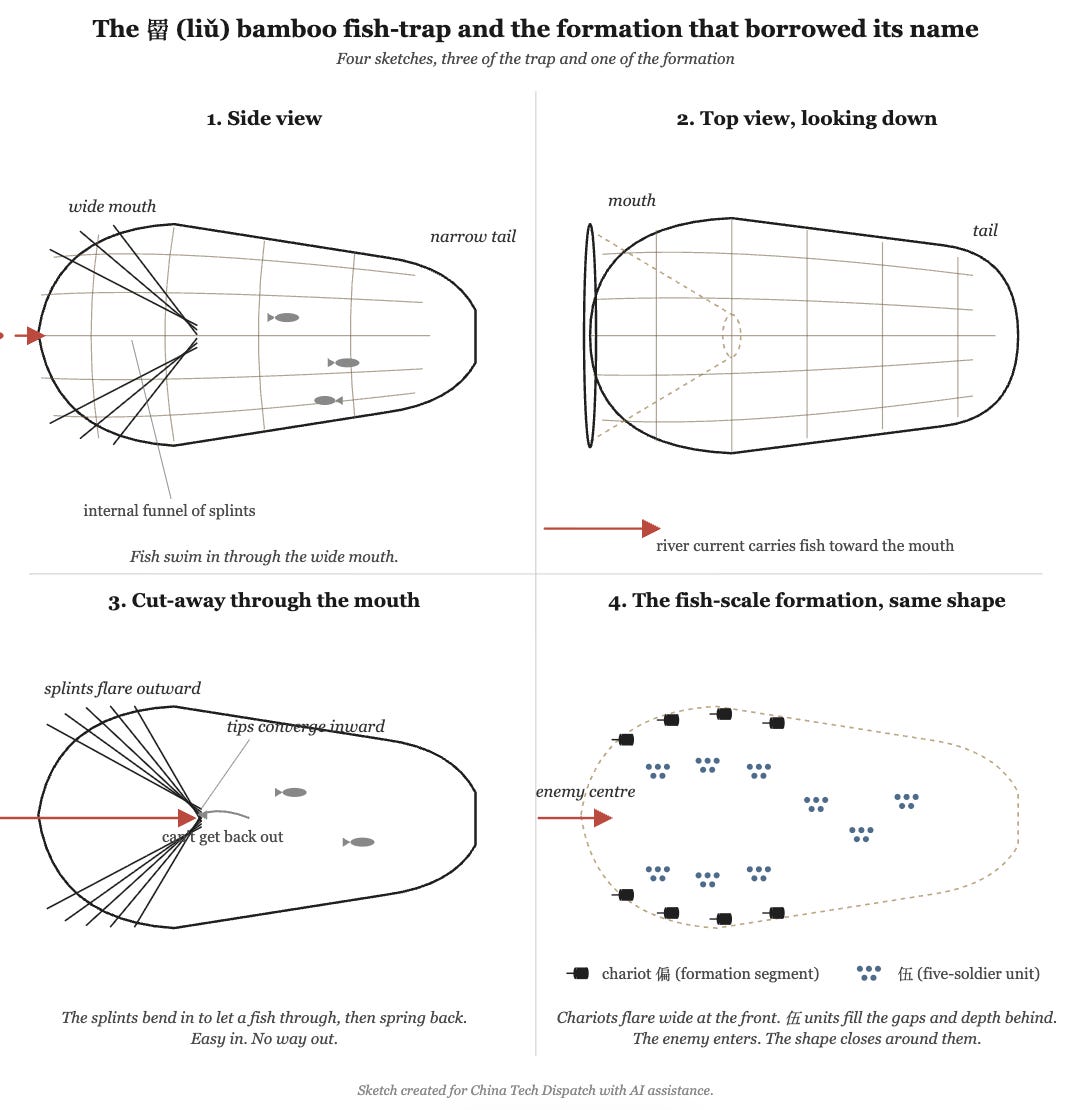
The name “fish-scale” evokes an image of overlapping armour plates, but that does not seems to be the case. The origin of name has multiple stories. The Zuo Zhuan (5th to 4th century BCE) is the earliest text to record the name. Whether Duke Zhuang’s army actually called the formation by this name or whether the name was applied later is not known. The authoritative Tang commentary by Kong Yingda refers 丽 as ‘pair’, following the older Erya dictionary. This indicates ‘fish paired’, and its connection to the formation’s chariot-plus-infantry pairing structure.
However, some sources available online tie the name to the Shijing poem 《小雅·鱼丽》 with its opening line 鱼丽于罶 (yú lì yú liǔ, ‘fish caught in the basket’). A 罶 (liǔ) is a bamboo fishing trap with a wide mouth and a narrow throat. Fish swim in easily. They cannot swim out. The formation probably borrowed the name because its operational logic was the same. Let the strong enemy centre push in, then trap it in depth with the infantry units filling the gaps behind. The front receives, the depth traps, and the enemy enters but cannot get out. Reading the formation’s name as “Fish-Trap formation” seems closer to how it must have been envisioned operationally.
Earlier Frontier Songs by Du Fu
Du Fu line the author quotes is the closing couplet of a poem 《前出塞》其六 (Qián Chūsài, qí liù, Earlier Frontier Songs, Number Six). In literary circles, it is understood to be a read as a critique of Tang Xuanzong’s expansionist border campaigns, specifically of General Geshu Han’s Tibetan operations. Du Fu was writing as the political situation around him was beginning to deteriorate, and the poem’s argument is that strong weapons and superior force should serve a defensive purpose rather than an expansionist one.
挽弓当挽强,用箭当用长。
射人先射马,擒贼先擒王。
杀人亦有限,列国自有疆。
苟能制侵陵,岂在多杀伤?
Translation (not official):
When drawing the bow, draw the strongest one.
When choosing arrows, choose the longest reach.
To shoot a man, first shoot his horse. To capture the bandit, first capture the chief.
Killing too has its limits. States have their own borders.
If aggression can be curbed, what need is there for widespread slaughter?
Thanks for reading. Until next time!
The Chinese title 公 (gōng) is the highest of the five Zhou nobility ranks 公侯伯子男 (gōng hóu bó zǐ nán), which English sinological convention renders as duke, marquis, count, viscount, and baron. The European feudal analogy is not exact, since the Zhou system organised vassal states inside a ritual hierarchy rather than a fief-and-tenant pyramid, but “duke” is the standard rendering used by major Anglophone scholarship on the period.
It took me some time to understand this historical texts arrangements clearly. The Zuo Zhuan (《左传》) is the earliest narrative commentary on the Spring and Autumn peropd (春秋), traditionally attributed to Zuo Qiuming (左丘明, Zuǒ Qiūmíng). The chronicle is organised by the reigns of the Lu state’s rulers rather than by the Zhou royal house, so the Xuge battle is recorded under 桓公五年 (Huángōng wǔ nián), meaning “Year 5 of Duke Huan of Lu” (鲁桓公, Lǔ Huán Gōng), corresponding to 707 BCE. This Lu Duke Huan is unrelated to the Zhou King Huan (周桓王, Zhōu Huán Wáng) who was defeated at the battle. The two share the posthumous name 桓 (huán) by coincidence. The text used for interpretation here is the standard received edition. The relevant Zuo Zhuan passage reads in part: 曼伯为右拒,祭仲足为左拒,原繁、高渠弥以中军奉公,为鱼丽之陈,先偏后伍,伍承弥缝.
First authoritative Xi use was 28 December 2017, when Xi addressed the annual conference of Chinese diplomatic envoys stationed abroad with the formulation 放眼世界,我们面对的是百年未有之大变局. The phrase was institutionalised at the June 2018 Central Conference on Work Relating to Foreign Affairs.
Clausewitz, Vom Kriege, Book 1, Chapter 1, Section 24.